
Secure shopping

Banking and insurance
The Banking & Insurance sector – often referred to as the lifeblood of the real economy – is of vital importance in the modern credit-driven economic growth model. Among its functions are intermediation between savers and borrowers, ensuring funds are allocated efficiently; support of payment and settlement systems that facilitate trade and international economic relations; and provision of various products that mitigate risk and uncertainty. The accelerating pace of technological change, stricter regulation and shifting consumer habits are reshaping the traditional banking model and pushing the sector towards innovation-led growth.
Activities associated with Banking & Insurance are depositary and non-depositary credit intermediation and related activities, investment banking, securities brokerage, commodity contracts dealing and diverse financial investment activities. The sector also includes insurers, re-insurers and insurance brokerages, pension funds, health and welfare funds, monetary authorities, stock exchanges, and collection and credit agencies.
The revenues of Brazil's telecommunication sector reached BRL 46.6bn in Q2 2025, increasing by 3.1% y/y. Meanwhile, the number of telecom subscribers (including mobile telephony, fixed broadband, fixed telephony and pay TV services) increased by 1.3% ...
View more details
Brazil's retail sector experienced a significant slowdown in Q2 2025, contrasting sharply with the robust start of the year. According to the monthly trade survey (PMC) by the Brazilian Institute of Geography and Statistics (IBGE), core retail sales ...
View more details
Through technology, fintechs have developed products that reach lower-income populations with limited access to credit and investment opportunities. As a result, fintechs have broadened credit availability and helped drive down the average lending ...
View more details
The biofuels sector in Brazil is an integrated industry with both domestic and global relevance. Thanks to its massive agricultural output, steady government support, and vast domestic market, the country ranks among the world's largest producers of ...
View more details
In 2024, Brazil's transport sector made significant progress across its core modes - roads, railways, aviation, and waterways - marking a period of recovery and institutional consolidation. While structural bottlenecks persist, the federal ...
View more details
Latin America is a key pharmaceutical and healthcare market. The region's growing economies, coupled with an ageing population and increased life expectancy across the board, translate to an ever-growing demand for medicine and health-related ...
View more details
The insurance sector in Colombia has evolved into a dynamic and increasingly competitive market, characterised by a diverse mix of local and international players that contribute to its steady expansion. The growing presence of global insurers, ...
View more details
Policy support, improving consumer awareness and rising affordability have been fuelling the global electric vehicle (EV) market for more than a decade now. With sales rising in double digits, EVs are gradually eating up into the market share of ...
View more details
In 2024, the Brazilian mining sector recorded a 4% y/y increase in production, reaching a record-high volume of 1,025.6mn tonnes - the highest level ever registered in the historical series, according to data from the National Mining Agency (ANM). ...
View more details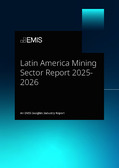
Latin America remains an important element of global mineral markets, underpinned by its abundant natural resources and relatively low domestic consumption. From Chile's and Peru's copper to Brazil's iron ore and niobium, and Mexico's precious metals ...
View more details